Understanding Market Cycles in Cryptocurrency
The cryptocurrency market, much like traditional financial markets, operates in recognizable patterns that unfold over time. These patterns, often referred to as market cycles, reflect shifts in supply and demand, investor sentiment, liquidity conditions, and broader economic influences. Although cryptocurrencies are relatively new compared to equities, bonds, or commodities, they demonstrate cyclical behavior that closely resembles long-observed financial phenomena.
Market cycles in cryptocurrency are often more pronounced due to the sector’s comparatively lower liquidity, evolving regulatory environment, technological innovation cycles, and high participation from retail investors. As a result, price swings can be substantial, and transitions between phases can occur more rapidly than in traditional markets. Understanding how these cycles function provides a structured framework for evaluating risk, timing strategies, and long-term portfolio positioning.
What Are Market Cycles?
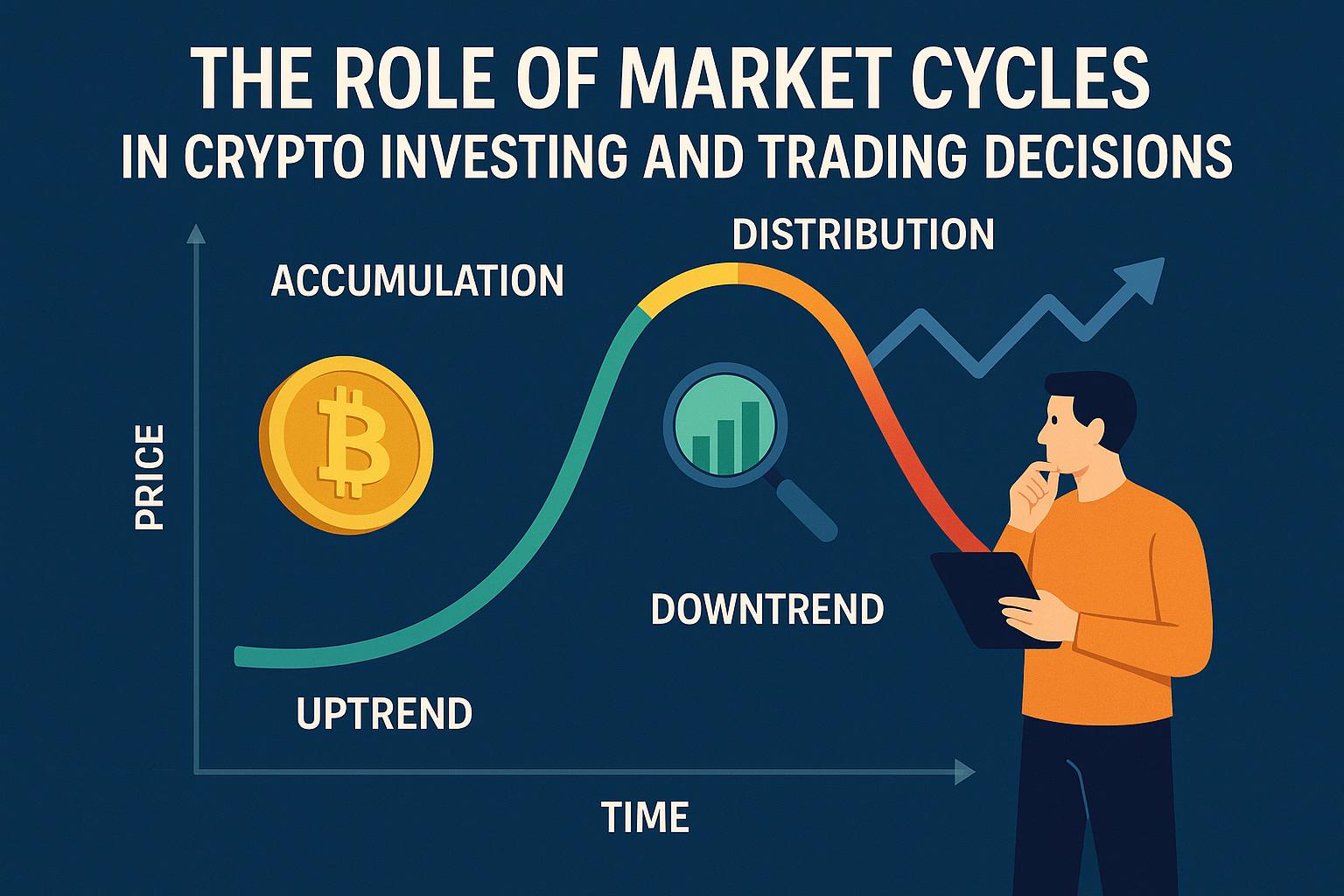
A market cycle is a sequence of recurring phases driven by changes in investor psychology, capital flows, and economic context. In cryptocurrency, these cycles typically consist of sustained upward trends followed by periods of consolidation and eventual decline. The duration of each phase can vary considerably, lasting months or even years.
At the core of every market cycle is the balance between accumulation and distribution. When prices are depressed and interest is low, long-term participants gradually acquire assets. When valuations become elevated and market participation broadens, those early participants may begin to reduce exposure. This dynamic creates the broad arc that defines cyclical behavior.
Cryptocurrency cycles are influenced not only by speculative trading but also by fundamental developments. Network upgrades, adoption milestones, macroeconomic policy changes, institutional involvement, and mining economics can all shape the progression of a cycle. In the case of Bitcoin, for example, supply-reducing events known as halvings have historically played a role in shaping multi-year cycles.
Cycles in Cryptocurrency
Although real-world market behavior rarely follows a perfectly symmetrical pattern, cryptocurrency cycles are often described through four primary phases: accumulation, markup, distribution, and markdown. Each phase exhibits distinct structural and behavioral characteristics.
Accumulation Phase:
The accumulation phase emerges after a prolonged decline or bear market. Prices stabilize following significant downward pressure, and volatility gradually decreases. Market sentiment is generally subdued, and media attention is limited. Retail participants who entered near previous highs may have already exited, leaving the market dominated by long-term investors and sophisticated participants.
During this phase, valuations often reflect pessimistic expectations. Trading volume may remain moderate but stable. Investors who believe in the long-term potential of the asset gradually build positions, often employing systematic entry strategies to manage risk. Accumulation periods can last for extended durations, reflecting uncertainty about whether the market has definitively reached a bottom.
Markup Phase:
The markup phase begins when demand consistently exceeds supply. Prices start to rise in a sustained manner, and higher highs and higher lows become visible on long-term charts. Initial gains may be driven by informed investors and institutions, but as momentum builds, broader participation follows.
Positive news coverage, technological progress, regulatory clarity, or macroeconomic shifts can accelerate this transition. As capital flows increase, liquidity deepens, and price appreciation becomes more pronounced. During later stages of the markup phase, rapid price increases can occur over relatively short periods.
Speculative activity often intensifies in this phase. New market participants enter, sometimes motivated more by recent gains than by long-term conviction. Leverage may increase, amplifying price swings.
Distribution Phase:
The distribution phase occurs when upward momentum slows and early investors begin to take profits. Prices may continue to rise temporarily, but volatility typically increases, and sharp reversals become more frequent. Market sentiment often remains optimistic, even as underlying strength begins to weaken.
Institutional players and experienced traders may gradually reduce positions without triggering immediate price collapse. The market can move sideways for a period, creating an appearance of consolidation near historical highs. Trading volume can fluctuate significantly as buyers and sellers compete for control.
Signs of exhaustion, such as declining volume during rallies or repeated failures to break new highs, may indicate that supply is beginning to outpace demand. However, identifying this phase in real time can be challenging, as sentiment often remains confident until a clear decline begins.
Markdown Phase:
The markdown phase represents a sustained decline in prices. Once the imbalance shifts decisively toward selling pressure, downward momentum builds. Stop-loss orders may be triggered, leveraged positions liquidated, and investor confidence gradually deteriorates.
Price declines during this stage may unfold in waves, interrupted by temporary recoveries. As losses accumulate, market participation can contract. Media sentiment often turns negative, and narratives shift toward risk avoidance and skepticism.
Eventually, selling pressure subsides as prices approach levels that attract renewed long-term interest. This transition marks the early stages of a new accumulation phase, completing the cycle.
Psychological Drivers Behind Market Cycles
While structural and economic factors influence cryptocurrency cycles, investor psychology plays a central role. Behavioral finance concepts such as herd behavior, recency bias, and overconfidence frequently contribute to exaggerated price movements.
During markup phases, positive feedback loops emerge. Rising prices attract attention, which draws in new buyers, further elevating prices. Conversely, markdown phases create negative feedback loops, where falling prices reinforce risk aversion and accelerate liquidation.
The relative immaturity of cryptocurrency markets can amplify psychological effects. Retail participation tends to be high, social media influences sentiment, and information spreads rapidly. As a result, cyclical extremes may be more pronounced than in more established markets.
The Role of Macroeconomic Factors
Cryptocurrency market cycles do not operate in isolation from the broader financial system. Interest rate policies, monetary liquidity, inflation expectations, and global economic stability can significantly influence capital allocation decisions.
Periods of expansive monetary policy and lower interest rates have historically encouraged investment into risk assets, including cryptocurrencies. Conversely, tightening financial conditions can reduce liquidity and shift capital toward lower-risk instruments.
Institutional adoption has strengthened the relationship between cryptocurrency and traditional asset markets. As large financial entities allocate capital to digital assets, correlations with equities, bonds, and macroeconomic indicators may increase. This interconnectedness can modify the duration and intensity of individual cycle phases.
The Importance of Timing and Strategy
Understanding the structure of market cycles allows investors and traders to contextualize price movements rather than reacting to short-term volatility alone. However, accurately determining the precise phase in real time is complex.
Timing involves evaluating technical indicators, on-chain data, macroeconomic signals, and sentiment measures collectively. No single metric definitively identifies transitions between phases. Instead, market participants rely on probabilistic assessments.
Long-term investors often focus less on exact timing and more on gradual position management. Traders, by contrast, may attempt to capitalize on shorter-term cyclical swings.
Investment Strategy
Investment approaches vary according to time horizon and risk tolerance. During accumulation phases, gradual allocation strategies such as dollar-cost averaging may reduce the impact of volatility. Investors may prioritize assets with strong network fundamentals, development activity, and sustainable tokenomics.
In markup phases, portfolio management becomes important to balance potential upside with increased risk. Rebalancing strategies may help maintain desired exposure levels as valuations rise. Some investors implement partial profit-taking strategies as prices deviate significantly from long-term valuation benchmarks.
During distribution and markdown phases, risk management becomes central. Reducing leverage, increasing diversification, and reassessing asset allocation can help manage downside exposure. Long-term investors may accept cyclical drawdowns, while shorter-term participants may seek defensive positioning.
Trading Considerations
For traders, cyclical awareness supports position sizing, entry timing, and risk controls. Technical analysis tools such as moving averages, trendlines, momentum oscillators, and volume indicators can assist in identifying potential phase transitions. On-chain metrics, including transaction volume, exchange inflows and outflows, and holder behavior, may provide additional insight.
Stop-loss orders and defined risk parameters are particularly relevant in volatile environments. Leverage should be approached cautiously, especially during late-stage markup or early markdown conditions when volatility tends to increase.
Short-term traders may attempt to profit from both upward and downward phases, depending on market structure and available instruments. Recognizing the broader cycle context can reduce the likelihood of trading counter to prevailing trends.
Risks and Considerations
Although market cycle analysis offers a structured framework, it does not eliminate uncertainty. Unpredictable events such as regulatory announcements, security breaches, geopolitical developments, or technological failures can disrupt established trends.
Cryptocurrency markets are also subject to structural shifts. As adoption grows and financial products evolve, historical cycle patterns may change. New derivatives markets, exchange-traded products, and institutional custody solutions can alter liquidity dynamics and investor behavior.
Diversification remains a central principle in managing cyclical risk. Allocating capital across multiple asset classes, sectors, or blockchain networks may reduce exposure to a single cycle’s volatility. Maintaining liquidity reserves can also provide flexibility during downturns.
Investors and traders should evaluate time horizon, capital constraints, and risk tolerance when applying cyclical analysis. Short-term volatility may be less relevant for participants with multi-year perspectives, while active traders require tighter controls.
Conclusion
Cryptocurrency markets exhibit cyclical behavior shaped by supply and demand dynamics, investor psychology, macroeconomic conditions, and technological development. The four primary phases—accumulation, markup, distribution, and markdown—provide a conceptual structure for interpreting price movements and adjusting strategic decisions.
While cycles cannot be predicted with certainty, understanding their characteristics enhances analytical discipline. By aligning investment and trading strategies with broader market context, participants can approach volatility with greater structure and risk awareness.
As the cryptocurrency ecosystem continues to mature, market cycles may evolve in duration and intensity. Nevertheless, the foundational principles of cyclical movement remain central to interpreting long-term price behavior and managing exposure in digital asset markets.
This article was last updated on: March 24, 2026