Understanding the Basics
When entering the cryptocurrency market, investors encounter several distinct categories of assets. The most commonly discussed are coins, tokens, and crypto-related stocks. Although these terms are sometimes used interchangeably in casual conversation, they refer to different structures, technologies, and investment exposures. Understanding the technical and economic differences between them is essential before allocating capital.
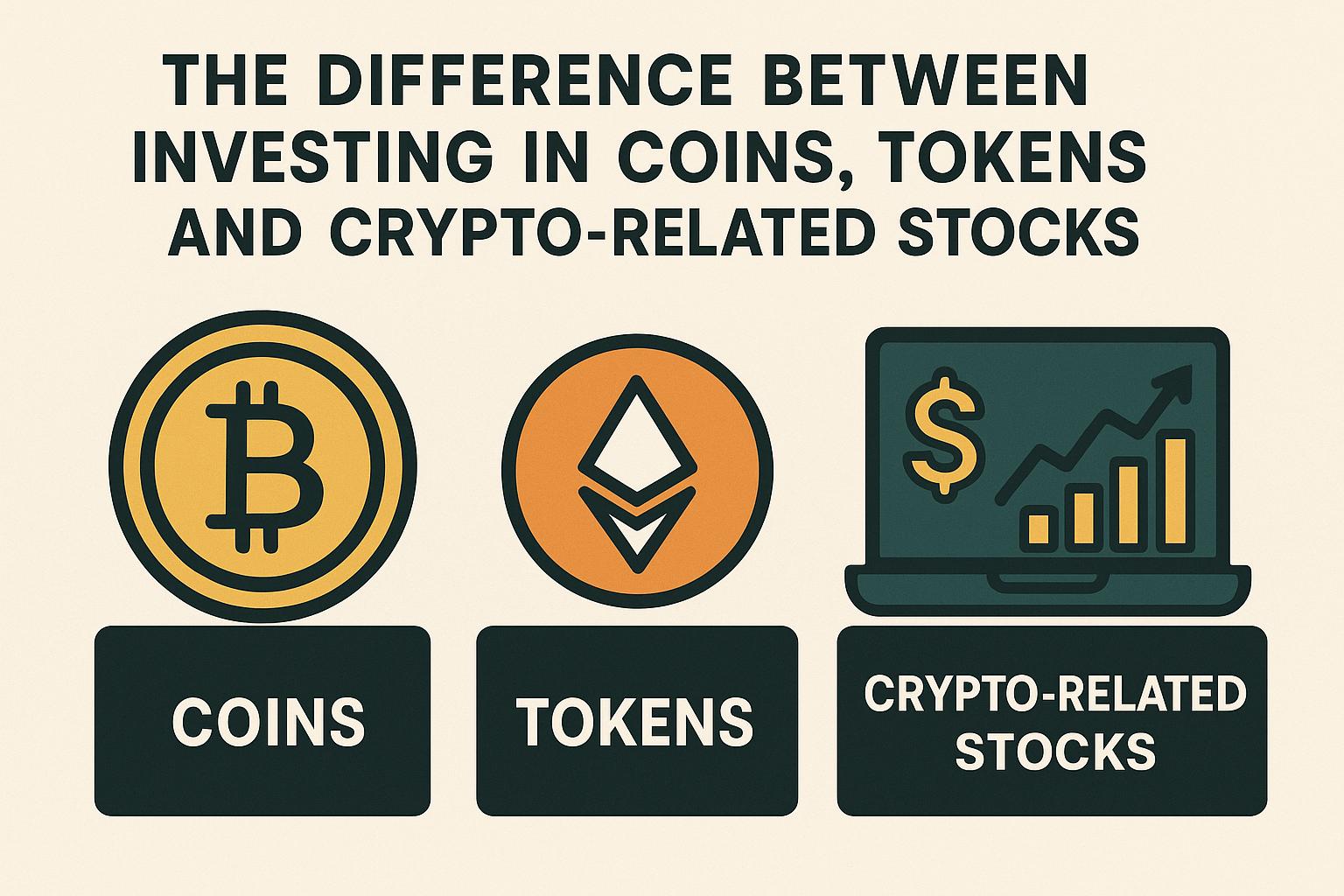
Each category reflects a different layer of the digital asset ecosystem. Coins typically represent native assets of independent blockchain networks. Tokens are digital assets created on top of existing blockchains and often serve specialized functions. Crypto-related stocks represent ownership in companies involved in blockchain or cryptocurrency operations. The distinction affects regulatory treatment, liquidity, volatility, and long-term investment potential.
Coins
Coins are digital currencies that operate on their own blockchain networks. A blockchain is a decentralized ledger maintained by a distributed network of computers that verify and record transactions. Bitcoin operates on the Bitcoin blockchain, while Ethereum runs on the Ethereum blockchain. These networks are autonomous systems with their own consensus mechanisms, such as proof-of-work or proof-of-stake.
Coins are typically used as mediums of exchange, stores of value, or units of account within their respective ecosystems. Bitcoin was designed primarily as a decentralized digital currency. Ethereum, while also functioning as a currency, serves an additional purpose by supporting smart contracts and decentralized applications.
Investing in coins generally involves evaluating the viability and adoption of the underlying blockchain. Investors consider factors such as network security, developer activity, scalability, transaction fees, governance structure, and long-term use cases. Since coins are integral to the operation of their networks, demand often rises as usage increases.
Volatility is a defining feature of coins. Price movements can be driven by macroeconomic trends, regulatory developments, technological upgrades, institutional interest, and shifts in market sentiment. Because coins trade globally and continuously, price discovery can be rapid. While this can present opportunities, it also introduces substantial risk.
Another important aspect of coins is their issuance model. Some have a capped supply, such as Bitcoin, which is limited to 21 million units. Others, like Ethereum, have more flexible monetary policies. Supply dynamics influence scarcity, inflation expectations, and long-term valuation frameworks.
Coins may also offer staking opportunities. In proof-of-stake systems, investors can lock up coins to help secure the network in exchange for rewards. This feature creates an additional source of potential return but also involves lock-up periods and operational considerations.
Tokens
Unlike coins, tokens are built on top of existing blockchains. Most commonly, tokens are created using standardized frameworks such as ERC-20 or ERC-721 on Ethereum. Rather than operating their own blockchains, tokens rely on the infrastructure and security of the underlying network.
Tokens can represent a wide range of assets and functionalities. Some provide access to a decentralized application. Others represent voting rights in governance systems. Still others track ownership of real-world assets. Because of this flexibility, the token category is broad and requires careful analysis.
Investing in tokens involves more than analyzing blockchain fundamentals. Investors must examine the purpose of the token, its distribution structure, supply schedule, and the demand drivers within its ecosystem. A token’s long-term viability depends largely on whether users need it to interact with a platform.
For example, many decentralized finance (DeFi) applications issue governance tokens. These allow holders to vote on changes to protocol parameters such as interest rates, collateral ratios, or reward structures. The value of such tokens is linked to user participation, platform revenue models, and competitive positioning within the DeFi ecosystem.
Tokens are often issued through mechanisms such as initial coin offerings (ICOs), initial exchange offerings (IEOs), or community distributions. Historically, token launches have experienced significant price volatility, partly due to speculative trading and evolving regulation.
Types of Tokens
Although token designs vary widely, they are commonly grouped into several broad categories.
Utility tokens provide access to a platform’s products or services. They function as digital access keys within decentralized networks. For example, a cloud storage network might require users to pay with its native token to store files. While some utility tokens trade on exchanges and can appreciate in price, their primary function is operational rather than investment-oriented.
Security tokens represent ownership interests in assets such as equity, debt, or revenue streams. They resemble traditional financial securities and are generally subject to securities regulation. Issuers must comply with disclosure requirements and investor protections. Security tokens aim to combine blockchain efficiency with established financial frameworks.
Another widely discussed category is the stablecoin. Stablecoins are tokens designed to maintain a stable value by being pegged to a reference asset, such as a fiat currency. They are commonly used for trading, settlement, and liquidity management within crypto markets. Although typically not viewed as growth investments, they play a central role in market structure.
Non-fungible tokens (NFTs) represent unique digital items rather than interchangeable units. These can include digital art, collectibles, or in-game assets. Investment considerations differ significantly due to their uniqueness and market dynamics. Pricing often depends on scarcity, creator reputation, and subjective demand.
Each token category requires separate risk assessment. Technical vulnerabilities in smart contracts, governance disputes, regulatory enforcement, and competitive pressures can affect token valuations.
Crypto-Related Stocks
Crypto-related stocks provide exposure to the cryptocurrency ecosystem through public equity markets. Rather than purchasing digital assets directly, investors buy shares of companies involved in blockchain development, cryptocurrency mining, trading platforms, or financial services linked to digital assets.
Examples include mining firms that operate large-scale data centers to validate blockchain transactions. Their profitability often depends on factors such as energy costs, hardware efficiency, and cryptocurrency prices. When coin prices rise, mining company revenues may increase; when prices fall, margins can compress significantly.
Exchange operators represent another category. These companies generate revenue from transaction fees, listing fees, and custodial services. Their performance may correlate with overall trading volume in crypto markets. Increased market participation tends to benefit these firms.
Some publicly listed companies hold substantial cryptocurrency reserves on their balance sheets. Their stock performance can therefore reflect both their core business activities and fluctuations in their digital asset holdings.
Investing in crypto-related stocks provides exposure within a regulated framework. Shares are traded on established stock exchanges, subject to corporate reporting standards, accounting oversight, and securities laws. This structure may offer transparency advantages relative to certain digital tokens.
However, crypto-related stocks introduce company-specific risks, including management decisions, debt levels, competitive strategy, and regulatory compliance. Their performance is not solely determined by cryptocurrency prices. Broader equity market trends, interest rates, and economic conditions also influence valuations.
Another distinction is trading hours. While cryptocurrencies trade continuously, stocks are limited to exchange operating times. This can create differing short-term volatility patterns.
Regulatory and Structural Differences
Regulation plays a critical role in distinguishing coins, tokens, and stocks. Coins such as Bitcoin are often classified as commodities in certain jurisdictions, while security tokens are treated under securities law. Regulatory classification affects taxation, reporting obligations, and investor protections.
Stocks operate in established legal frameworks with shareholder rights, voting procedures, and disclosure requirements. Cryptocurrencies operate in a more fragmented regulatory landscape that varies by country.
Custody arrangements also differ. Holding coins or tokens generally requires digital wallets and private key management. Losing access to private keys can result in permanent loss of funds. Stocks, by contrast, are typically held through brokerage accounts, and ownership records are managed by centralized systems.
Market structure varies as well. Cryptocurrency exchanges operate globally, often with varying standards for listing and compliance. Equity markets are centralized within national regulatory environments. These differences can influence liquidity, transparency, and price stability.
Comparing Risk Profiles
Risk assessment differs across coins, tokens, and crypto-related stocks. Coins tend to exhibit high price volatility and are highly sensitive to changes in market sentiment and macroeconomic trends. Tokens can experience even greater volatility due to their dependence on early-stage projects and evolving use cases.
Smart contract risk is unique to tokens. Coding errors or exploits can lead to financial losses. Governance risk is also significant, particularly in decentralized systems where decision-making is distributed among token holders.
Crypto-related stocks generally show lower volatility than many digital assets but remain more volatile than broad market indices. Their risk profile combines traditional business risks with cryptocurrency exposure.
Liquidity also varies. Major coins like Bitcoin and Ethereum typically have deep markets with significant trading volume. Smaller tokens may have limited liquidity, making large transactions more difficult. Stocks of larger, established companies tend to be more liquid than those of smaller firms.
Portfolio Considerations
Determining how to allocate among coins, tokens, and crypto-related stocks requires alignment with investment objectives, time horizon, and risk tolerance. Some investors pursue direct exposure to blockchain adoption through coins. Others focus on tokens associated with decentralized finance or emerging applications. More conservative investors may prefer crypto-related stocks due to regulatory familiarity.
Diversification can reduce exposure to any single risk factor. Allocating across multiple asset types may help mitigate the impact of project-specific or company-specific setbacks. However, diversification within the cryptocurrency sector does not eliminate exposure to systemic market downturns.
Investors should also evaluate liquidity needs. Digital assets can typically be traded at any time, but market depth varies. Stocks provide standardized settlement systems but limited trading hours.
Tax treatment must be considered as well. Cryptocurrency transactions may be treated as taxable events in many jurisdictions. Staking rewards, token distributions, and capital gains can have reporting implications. Stock dividends and capital gains follow established tax rules that may differ from digital asset taxation.
Technological Evolution and Market Maturity
The cryptocurrency sector continues to evolve rapidly. Protocol upgrades, scaling solutions, regulatory developments, and institutional participation shape long-term prospects. Coins may gain value as infrastructure matures and real-world adoption increases. Tokens may benefit from innovation in decentralized finance, gaming, identity systems, and digital ownership frameworks.
Crypto-related stocks may adapt by expanding services, improving operational efficiency, or integrating new blockchain capabilities. As market infrastructure develops, distinctions between traditional financial assets and blockchain-based assets may become more closely integrated.
However, technological uncertainty remains. Competing protocols can reduce network dominance. Regulatory interventions can alter market structure. Security breaches and technical failures can undermine confidence.
Overall Considerations
Selecting between coins, tokens, and crypto-related stocks requires careful analysis of structural differences, technological foundations, regulatory frameworks, and individual risk tolerance. Each category provides exposure to the broader digital asset ecosystem but through different mechanisms.
Coins represent foundational blockchain networks. Tokens build specialized applications on these networks. Crypto-related stocks provide indirect exposure through corporate entities operating within or alongside the sector.
Thorough research, disciplined risk management, and portfolio diversification are central to navigating this complex environment. The cryptocurrency space offers a range of opportunities, but its structure differs significantly from traditional investment markets. Understanding these distinctions forms the basis for informed decision-making in an evolving financial landscape.
This article was last updated on: April 30, 2026