Understanding Crypto Portfolio Allocation
When venturing into the realm of cryptocurrency investments, it is essential to tailor your portfolio according to your individual risk tolerance, time horizon, and broader financial objectives. Cryptocurrencies represent a distinct asset class characterized by high price volatility, evolving regulatory oversight, and rapid technological development. These features create both opportunity and uncertainty. A structured allocation approach provides a framework for navigating these conditions while aligning investment behavior with clearly defined financial goals.
Portfolio allocation in the cryptocurrency context refers to determining how much capital to assign to digital assets overall and how to distribute that capital among different types of cryptocurrencies. Allocation is not limited to selecting specific coins or tokens. It also involves deciding the proportion of capital to dedicate to established assets, emerging projects, infrastructure tokens, and decentralized finance applications. A disciplined strategy reduces the likelihood of overexposure to a single asset and helps manage risk during periods of market stress.
The Role of Asset Allocation in Portfolio Construction
In traditional finance, asset allocation has long been considered a primary driver of portfolio performance and volatility. The same principle applies to digital assets. Cryptocurrencies may behave independently of traditional stocks and bonds during certain periods, but they are still subject to macroeconomic forces, liquidity cycles, and investor sentiment. For this reason, integrating cryptocurrency exposure into a broader portfolio requires careful evaluation of correlations, liquidity, and concentration risk.
A comprehensive allocation strategy typically begins with a decision about the overall percentage of net investable assets that should be placed in cryptocurrency. This determination depends on risk capacity, which refers to the investor’s financial ability to tolerate losses, and risk tolerance, which refers to psychological comfort with volatility. Once the overall allocation is established, attention turns to diversification within the crypto segment itself.
Risk Profiles and Their Importance
A risk profile reflects an investor’s willingness and capacity to accept fluctuations in portfolio value in pursuit of potential returns. In the cryptocurrency market, where double-digit percentage price movements within short timeframes are common, accurately assessing risk profile is particularly important.
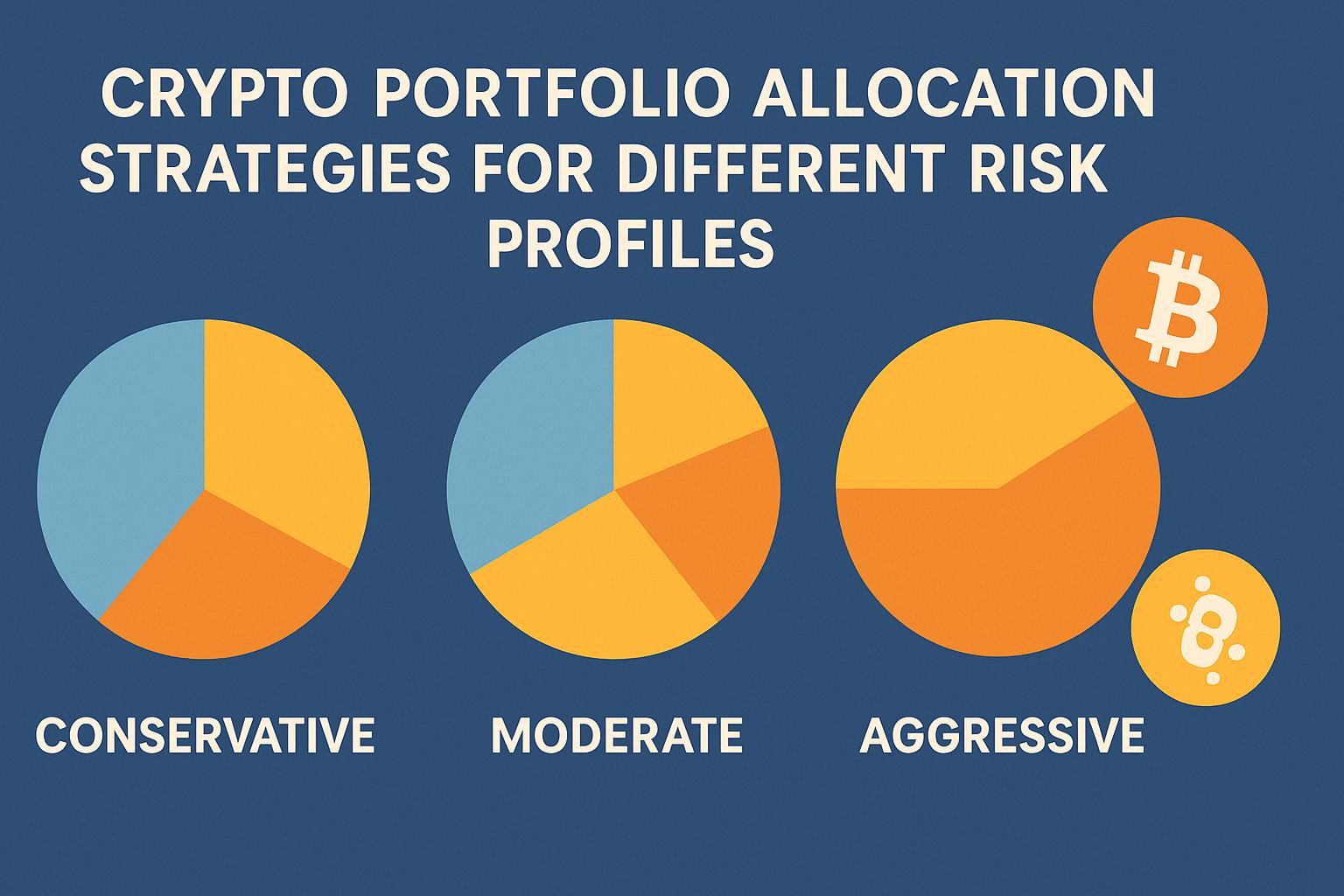
Risk profiles can generally be grouped into conservative, moderate, and aggressive categories. These classifications are not rigid but provide a useful framework for determining suitable exposure levels and asset selection. Moving from conservative to aggressive profiles typically increases exposure to smaller, less established projects and innovations with greater uncertainty.
Understanding one’s risk profile also helps prevent behavioral mistakes. Investors who exceed their tolerance for volatility may be more likely to make reactive decisions during downturns, while investors who under-allocate relative to their risk capacity may miss out on potential long-term growth.
Conservative Investors
Conservative investors prioritize capital preservation and steady growth over high-risk, high-reward opportunities. They are generally sensitive to drawdowns and may rely on their investment portfolios for near-term financial objectives or retirement income. For this group, cryptocurrency exposure should represent a modest portion of total investable assets, commonly in the range of 1 to 5 percent.
Within the cryptocurrency allocation itself, conservative investors often concentrate on the most established digital assets. Bitcoin (BTC) is typically considered the foundational cryptocurrency due to its market capitalization, liquidity, and relatively longer track record. Ethereum (ETH), as a leading smart contract platform, also holds a significant position in many conservative crypto allocations.
While these assets remain volatile compared to traditional securities, they historically exhibit lower risk relative to smaller-cap cryptocurrencies. Concentrating on large-cap digital assets reduces exposure to technological, liquidity, and execution risk that may be more prevalent in emerging projects.
Example Allocation for Conservative Investors
Within a crypto allocation that represents a small percentage of the overall portfolio, a conservative structure might place approximately 60 percent in Bitcoin and 40 percent in Ethereum. This proportion emphasizes Bitcoin’s position as a store-of-value–oriented asset while recognizing Ethereum’s role in facilitating decentralized applications and blockchain-based infrastructure.
In addition to selecting established assets, conservative investors may prioritize operational security. Some may choose regulated custodial solutions that manage private keys on their behalf, reducing technical complexity and the risk of self-custody errors. Attention to secure storage practices, two-factor authentication, and compliance standards forms part of a broader risk management approach.
Moderate Investors
Moderate investors are prepared to accept higher levels of volatility in pursuit of stronger long-term growth. They typically maintain diversified portfolios across asset classes and may allocate between 5 and 15 percent of total investable assets to cryptocurrencies.
While Bitcoin and Ethereum often remain the foundation of the crypto allocation, moderate investors expand exposure to include large-cap altcoins with significant market adoption and defined use cases. These may involve layer-1 blockchain platforms, infrastructure providers, or tokens supporting decentralized ecosystems.
Diversification within this category typically reflects varied functional roles. Some tokens may focus on transaction processing and scalability, while others emphasize interoperability or decentralized application support. The goal is not merely diversification by name but diversification by technological purpose and market segment.
Example Allocation for Moderate Investors
A representative structure could allocate roughly 50 percent of the crypto segment to Bitcoin, 30 percent to Ethereum, and 20 percent to a basket of large-cap altcoins. The altcoin component might include established networks such as Cardano, Solana, or other high-market-cap platforms with active development communities and measurable usage.
This approach balances the relative stability of established digital assets with incremental exposure to innovation-driven growth. Moderate investors may also rebalance periodically, adjusting weightings based on changes in market capitalization, regulatory developments, or portfolio drift.
Aggressive Investors
Aggressive investors seek substantial growth and are comfortable with pronounced volatility and extended drawdowns. They often possess longer time horizons, higher income streams, or diversified holdings outside the crypto asset class that allow them to tolerate significant fluctuations.
Such investors may allocate more than 15 percent of their total portfolio to cryptocurrencies, and in some cases substantially more. Within the crypto segment, allocation may extend beyond large-cap coins to include mid-cap and small-cap altcoins, decentralized finance projects, and specialized tokens tied to emerging sectors such as scaling solutions, interoperability protocols, and tokenized real-world assets.
The additional exposure to smaller market capitalization assets introduces higher potential returns but also heightened risk. These tokens may face liquidity constraints, governance challenges, or technological vulnerabilities. Continuous monitoring becomes essential to ensure that project fundamentals remain intact.
Example Allocation for Aggressive Investors
An illustrative composition might include approximately 40 percent of the crypto allocation in Bitcoin, 20 percent in Ethereum, 20 percent in large-cap altcoins, 10 percent in mid-cap tokens, and 10 percent in small-cap or decentralized finance projects. This layered approach combines foundational assets with growth-oriented components.
Because smaller tokens can experience rapid appreciation or significant declines, aggressive investors often implement structured rebalancing strategies. Rebalancing may involve trimming positions that outperform to manage concentration risk and reallocating proceeds to underweighted segments, thereby maintaining discipline.
Diversification Within the Crypto Ecosystem
Diversification in cryptocurrency extends beyond market capitalization. Investors may distribute capital across different functional categories. Store-of-value assets like Bitcoin serve a distinct purpose compared to smart contract platforms such as Ethereum. Infrastructure tokens, exchange tokens, governance tokens, and utility tokens each represent different economic models.
Geographic exposure also plays a role. Some blockchain projects maintain strong developer communities in particular regions, which may influence regulatory sensitivity and adoption trends. Additionally, consensus mechanisms vary, including proof-of-work and proof-of-stake, each carrying different security assumptions and energy considerations.
By allocating across categories, investors mitigate reliance on a single technological thesis. If one segment underperforms due to technical or regulatory constraints, other segments may offset losses.
Factors Influencing Allocation Decisions
Several key factors shape cryptocurrency portfolio allocation. These influences evolve over time and must be reevaluated periodically.
Market Conditions
Crypto markets operate in cycles characterized by expansion and contraction. During bullish phases, liquidity and speculative interest tend to increase, often benefiting smaller-cap assets. In contrast, market contractions frequently lead to capital rotating toward more established assets such as Bitcoin. Allocation strategies may adapt to these cycles, though frequent trading introduces transaction costs and execution risk.
Technological Developments
Blockchain innovation remains active. Protocol upgrades, scalability improvements, and interoperability solutions can alter competitive dynamics between networks. Investors with aggressive profiles may increase exposure to projects implementing significant upgrades, while conservative investors may wait for sustained adoption before reallocating capital.
Regulatory Environment
Regulatory clarity or uncertainty can materially affect digital asset valuations. Policy announcements related to exchange compliance, taxation, securities classification, or institutional access can influence demand and liquidity. Investors often adjust allocations in response to shifting regulatory trajectories, especially in major markets.
Macroeconomic Factors
Interest rates, inflation expectations, and global liquidity conditions also influence cryptocurrency performance. Tight monetary policy can reduce speculative capital availability, while expansive policy may increase liquidity in risk-oriented assets. Although crypto markets operate independently in certain respects, they remain connected to global financial conditions.
Rebalancing and Risk Management
Allocation is not a one-time exercise. Over time, price fluctuations cause portfolio weights to shift. A disciplined rebalancing schedule—such as quarterly or semiannually—can help maintain target exposure levels.
Rebalancing serves two purposes. First, it controls concentration risk by preventing a single outperforming asset from dominating the portfolio. Second, it enforces a systematic approach to buying and selling, reducing emotional decision-making.
Risk management may also include position sizing limits, scenario analysis, and liquidity assessment. Investors should avoid committing capital needed for short-term obligations, given the possibility of extended volatility. Maintaining an emergency fund outside of cryptocurrency holdings reduces pressure to liquidate positions during unfavorable market conditions.
Time Horizon and Investment Objectives
Time horizon significantly influences allocation decisions. Investors with longer investment horizons may tolerate greater short-term volatility because they have additional time for potential recovery. Shorter-term investors may prioritize liquidity and capital stability.
Objectives differ as well. Some investors view cryptocurrency as a speculative growth asset. Others treat it as a strategic allocation to digital infrastructure. Clarity of purpose supports consistency in allocation decisions and reduces reaction to short-term price movements.
Operational Considerations
Beyond asset selection, operational factors affect portfolio integrity. Secure storage of private keys is fundamental. Investors may choose between self-custody solutions, hardware wallets, multisignature arrangements, or regulated custodial providers. Each option presents trade-offs between control, complexity, and counterparty risk.
Taxation also influences allocation decisions. In many jurisdictions, cryptocurrency transactions trigger taxable events. Frequent trading may increase administrative complexity and tax liability. A structured allocation approach with periodic rebalancing may reduce excessive transactions.
Liquidity assessment is another operational consideration. Large-cap cryptocurrencies typically offer deep liquidity across exchanges, while smaller-cap tokens may have limited trading volume. Investors must account for potential slippage when entering or exiting positions.
Integrating Crypto With Traditional Portfolios
Cryptocurrency allocation should be evaluated in the context of the broader investment portfolio. Traditional asset classes such as equities, bonds, real estate, and cash equivalents provide varying degrees of stability and income generation. Crypto exposure may increase overall portfolio volatility, particularly if allocation percentages exceed moderate levels.
Correlation analysis can inform decisions. Although crypto has at times demonstrated low correlation with traditional markets, periods of systemic stress may increase alignment with risk assets. Investors should consider overall portfolio drawdown potential when determining crypto exposure.
For institutional or high-net-worth investors, portfolio optimization models may incorporate historical volatility, expected return assumptions, and covariance matrices to calculate efficient frontier allocations. While historical performance does not guarantee future outcomes, quantitative modeling can support structured decision-making.
Conclusion
Cryptocurrency portfolio allocation requires deliberate planning grounded in risk assessment, diversification principles, and ongoing monitoring. Conservative investors may limit exposure to a small percentage of total assets and focus on established cryptocurrencies. Moderate investors may broaden diversification to include high-market-cap altcoins while maintaining foundational positions. Aggressive investors may extend allocation into mid-cap, small-cap, and decentralized finance projects, accepting greater volatility in pursuit of higher potential returns.
External influences such as regulatory changes, technological advancements, and macroeconomic trends continually reshape the digital asset landscape. As a result, portfolio allocation is a dynamic process rather than a static decision. Regular evaluation, disciplined rebalancing, and adherence to predefined risk parameters contribute to structured long-term management.
By aligning crypto exposure with financial objectives, time horizon, and tolerance for volatility, investors can integrate digital assets into a comprehensive investment framework while maintaining prudent risk oversight.
This article was last updated on: April 15, 2026