Understanding Layer 2 Solutions in the Blockchain Ecosystem
Layer 2 solutions have become a central element in the development of blockchain infrastructure. As public blockchains such as Ethereum and Bitcoin gained widespread use, their limitations in transaction throughput, cost efficiency, and latency became more pronounced. Layer 1 networks provide security, consensus, and decentralization, but they often struggle to process a high volume of transactions without experiencing congestion and elevated fees. Layer 2 solutions are designed to address these limitations while continuing to rely on the underlying Layer 1 for final settlement and security guarantees.
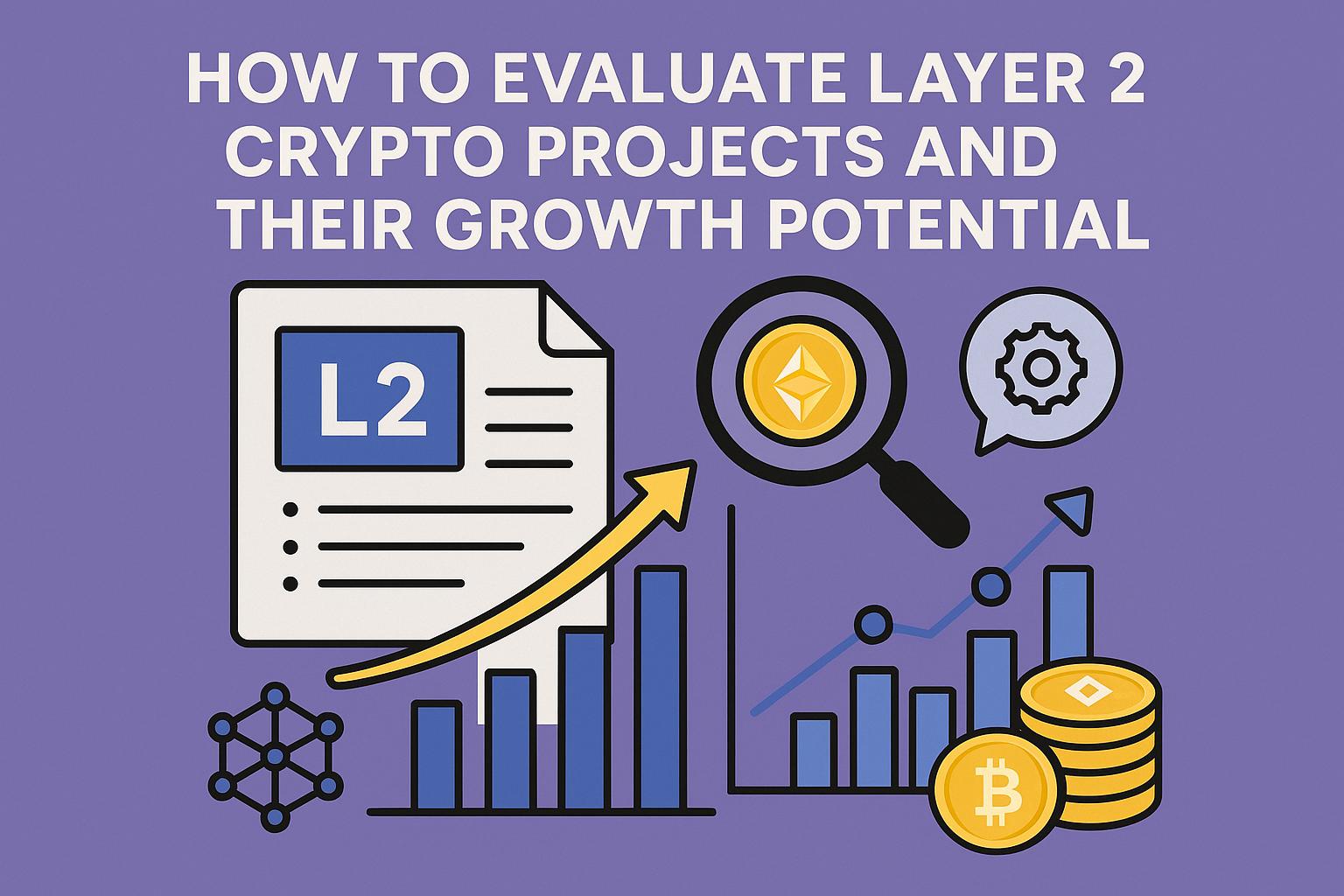
Evaluating the growth potential of Layer 2 crypto projects requires a careful examination of technical, economic, and ecosystem-related considerations. These projects do not operate in isolation; their role is integrative. They extend the capabilities of existing blockchains, making them more practical for large-scale applications such as decentralized finance, gaming, supply chain management, and enterprise integration.
Scalability and Technical Architecture
At the foundation of any Layer 2 project lies its scalability potential. Scalability refers to the ability of a blockchain system to handle increased demand without compromising performance or security. Traditional Layer 1 networks process transactions sequentially and require widespread consensus, which can limit throughput. Layer 2 solutions modify this framework by moving some or most transaction execution away from the base chain while still leveraging its settlement layer.
Different types of Layer 2 architectures exist, each with distinct trade-offs. State channels allow participants to conduct numerous transactions off-chain and only settle the final result on-chain. This approach reduces on-chain load significantly but may require participants to remain online and lock funds during the channel’s lifespan. Sidechains operate as independent blockchains with their own consensus mechanisms, periodically anchoring to the main chain. While this enhances flexibility and throughput, it may introduce varying degrees of security reliance independent of the Layer 1.
More recently, rollups have become prominent, particularly within the Ethereum ecosystem. Rollups aggregate many transactions into a single batch and submit compressed data to the main chain. There are two primary forms: optimistic rollups and zero-knowledge (ZK) rollups. Optimistic rollups assume transactions are valid by default and provide a challenge mechanism for fraud detection. ZK rollups generate cryptographic proofs attesting to transaction validity before submission. Each system offers different performance characteristics and cost structures.
When assessing a Layer 2 project, it is important to examine how effectively its architecture reduces transaction costs, increases throughput, and maintains compatibility with existing smart contracts. Projects that achieve measurable improvements, such as higher transactions per second and significantly lower fees, are better positioned for sustained growth. Technical clarity in documentation and transparent benchmarking are additional indicators of maturity.
Security and Decentralization
Security remains a primary concern for any blockchain-based solution. Although Layer 2 systems operate partially off-chain, they must ultimately inherit or anchor their security in the Layer 1 network. A strong Layer 2 project clearly defines how disputes are resolved, how transaction validity is verified, and how funds are protected in the event of malicious behavior.
Optimistic rollups depend on fraud proofs and challenge periods to ensure valid transaction execution. This introduces a delay before withdrawals can be finalized but provides a decentralized security framework aligned with the base chain. ZK rollups rely on validity proofs created through cryptographic computations. These proofs confirm correctness without revealing underlying data, offering potentially faster finality but requiring sophisticated cryptographic infrastructure.
Sidechains may employ their own validators and consensus models, which means their security may not be as tightly coupled to the Layer 1 chain. In such cases, evaluating validator incentives, decentralization of control, and mechanisms for preventing collusion becomes critical.
Maintaining decentralization is equally important. A Layer 2 solution controlled by a small group of operators or reliant on centralized components may achieve performance gains but at the cost of trust minimization. Decentralization can be assessed by reviewing validator distribution, governance structures, and transparency in protocol upgrades. Projects that provide open participation in node operation and transparent governance processes tend to align more closely with the principles of public blockchain systems.
Interoperability
Interoperability enhances the adaptability of Layer 2 networks. A solution that operates exclusively within a narrow technical scope may encounter limitations in user reach and integration. In contrast, projects designed with broad compatibility can enable cross-chain interactions, expanding liquidity, user base, and functional diversity.
Interoperability typically involves the use of standardized communication protocols, token bridges, or shared security frameworks. Some Layer 2 projects focus on compatibility with Ethereum’s virtual machine, enabling developers to deploy existing smart contracts without major modifications. This compatibility reduces migration barriers and accelerates adoption.
Cross-chain capabilities must also be evaluated in terms of security. Token bridges and messaging systems are frequent targets for exploits. Effective interoperability mechanisms rely on secure validation models and rigorous auditing. Growth potential is enhanced when a project demonstrates that it can integrate with other ecosystems without exposing users to disproportionate risk.
The broader blockchain landscape is increasingly multi-chain. Applications often interact with multiple networks for liquidity, asset transfers, and specialized computations. Layer 2 solutions that position themselves as infrastructure connectors rather than isolated extensions may capture a larger share of this evolving ecosystem.
Economic Design and Incentive Structures
Beyond technical considerations, the economic framework of a Layer 2 project influences its sustainability. Token models, fee distribution mechanisms, and validator incentives must align with long-term participation and stability. An assessment of economic design includes examining supply schedules, reward structures, and how network fees are allocated.
Some Layer 2 networks utilize native tokens for governance, staking, or transaction processing. In such cases, evaluating token utility is essential. If the token plays a meaningful role in securing the network or enabling governance participation, it may support ecosystem longevity. Conversely, tokens with limited functional necessity may face adoption constraints.
Transaction fee models should also be clear and predictable. Excessively complex fee calculations or hidden costs can discourage usage. Sustainable projects often implement transparent models where a portion of fees supports network security while another portion incentivizes development or treasury growth.
Validator or sequencer roles require thorough analysis. In many rollup designs, a sequencer orders transactions before submission to the main chain. If sequencing authority is centralized, it could create bottlenecks or governance concerns. Projects that transition toward decentralized sequencing models may demonstrate stronger long-term resilience.
Governance and Protocol Evolution
Blockchain ecosystems evolve continuously. Governance structures determine how upgrades are proposed, evaluated, and implemented. Effective governance balances decentralization with operational efficiency. Layer 2 projects must manage technical upgrades, parameter adjustments, and integration updates without undermining security.
Some networks adopt on-chain governance, allowing token holders to vote on proposals. Others rely on foundation-led governance with advisory input from developers and the community. Evaluating transparency, voting participation, and documented improvement proposals provides insight into governance maturity.
Protocol evolution also relates to adaptability. As Layer 1 networks introduce upgrades—such as data availability enhancements or fee model revisions—Layer 2 systems must adjust accordingly. Projects with modular architectures and forward-compatible designs are generally better prepared to integrate improvements without significant disruptions.
Community and Developer Support
The engagement of users and developers plays a significant role in determining the trajectory of a Layer 2 project. Active development communities contribute code improvements, identify vulnerabilities, and create applications that expand network utility. Indicators of developer engagement include consistent updates, publicly accessible documentation, and regular protocol improvements.
A strong developer ecosystem fosters innovation. When third-party teams build decentralized applications on a Layer 2 network, transaction volume and network relevance increase. Developer grants, hackathons, and technical support programs reflect active ecosystem cultivation.
User communities contribute through feedback, governance participation, and adoption advocacy. Transparent communication channels, including technical forums and regular progress updates, demonstrate organizational stability and accountability. Community-driven projects often experience more distributed growth, reducing dependence on a single entity.
Real-World Use Cases
Layer 2 adoption ultimately depends on practical application. Projects that address identifiable market needs often demonstrate stronger growth trajectories. Use cases may include microtransactions, decentralized exchanges, lending platforms, non-fungible token marketplaces, and gaming ecosystems.
For microtransactions, low fees and fast confirmation times are critical. Layer 2 solutions that provide near-instant settlement at minimal cost can support payment models unsuitable for base-layer blockchains. In decentralized finance, scalability improvements allow for more complex trading strategies and higher liquidity participation.
Gaming and digital identity applications require high transaction throughput and predictable fees. Layer 2 systems that integrate seamlessly with user-facing applications may become foundational infrastructure in these sectors. Enterprise adoption may focus on supply chain verification or data anchoring, where scalability and privacy features are essential.
The clarity of a project’s target market contributes to evaluative accuracy. Projects with defined integration pathways and documented implementation cases offer more concrete evidence of viability than those relying solely on theoretical performance claims.
Partnerships and Institutional Integration
Strategic collaborations can enhance technological credibility and accelerate user acquisition. Partnerships with established blockchain networks, enterprise technology providers, or infrastructure services indicate interoperability and industry recognition.
Institutional involvement, such as venture investment or research collaboration, may provide capital and technical resources. However, evaluation should distinguish between marketing announcements and substantive integration. The depth of collaboration—such as shared development efforts or co-deployed applications—offers a clearer measure of long-term impact.
Layer 2 projects integrated directly into major wallets, exchanges, or decentralized finance platforms often benefit from immediate user exposure. Seamless fiat on-ramps or custodial integrations may further expand adoption.
Regulatory and Compliance Considerations
Regulatory frameworks surrounding blockchain technology continue to evolve. Although Layer 2 systems focus primarily on technical scalability, they operate within broader legal environments. Compliance considerations may include token classification, data privacy obligations, and anti-money laundering requirements for associated applications.
Projects that maintain transparent corporate structures or collaborate with regulatory bodies may face fewer operational interruptions. While decentralization minimizes reliance on centralized entities, governance tokens and funding models still intersect with regulatory systems in many jurisdictions.
Evaluating how a project addresses compliance risks contributes to a more comprehensive understanding of its growth stability.
Long-Term Sustainability and Competitive Positioning
The Layer 2 landscape is increasingly competitive. Multiple projects may address similar scalability issues using comparable technologies. Differentiation often lies in performance optimization, ecosystem support, or specialized focus areas.
Long-term sustainability depends on continued development, user retention, and adaptability. Metrics such as total value locked, transaction volume, and developer activity provide quantitative indicators of network utilization. However, qualitative assessments—including documentation quality, leadership transparency, and upgrade roadmap clarity—are equally relevant.
Layer 2 solutions must also respond to improvements at the Layer 1 level. For instance, if a base blockchain significantly increases its native throughput, certain Layer 2 advantages may narrow. Projects that anticipate such developments and position themselves as complementary infrastructure rather than temporary scaling fixes are better suited for continued relevance.
Conclusion
Layer 2 solutions play a critical role in advancing the functionality and usability of blockchain networks. By expanding transaction capacity, reducing fees, and preserving decentralization, they enable blockchains to support a broader range of applications. Assessing the growth potential of Layer 2 crypto projects requires a multidimensional approach that encompasses technical architecture, security integration, interoperability, economic design, governance, and ecosystem engagement.
Careful evaluation of scalability models, validator structures, token incentives, community activity, and real-world adoption provides a structured framework for analysis. Projects that combine technical robustness with transparent governance, practical use cases, and sustainable incentive systems are generally better positioned within the evolving blockchain ecosystem. Through comprehensive assessment, stakeholders can gain a clearer understanding of how Layer 2 innovations may shape the future of decentralized infrastructure.
This article was last updated on: April 8, 2026