Introduction
Layer 1 blockchains represent the base protocol layer of a distributed ledger system. They are responsible for transaction validation, consensus, and the native asset that powers the network. Unlike Layer 2 solutions, which operate on top of existing chains to improve performance or reduce costs, Layer 1 blockchains define the core rules of participation and security. Because of this foundational role, they attract sustained investor attention and significant capital allocation.
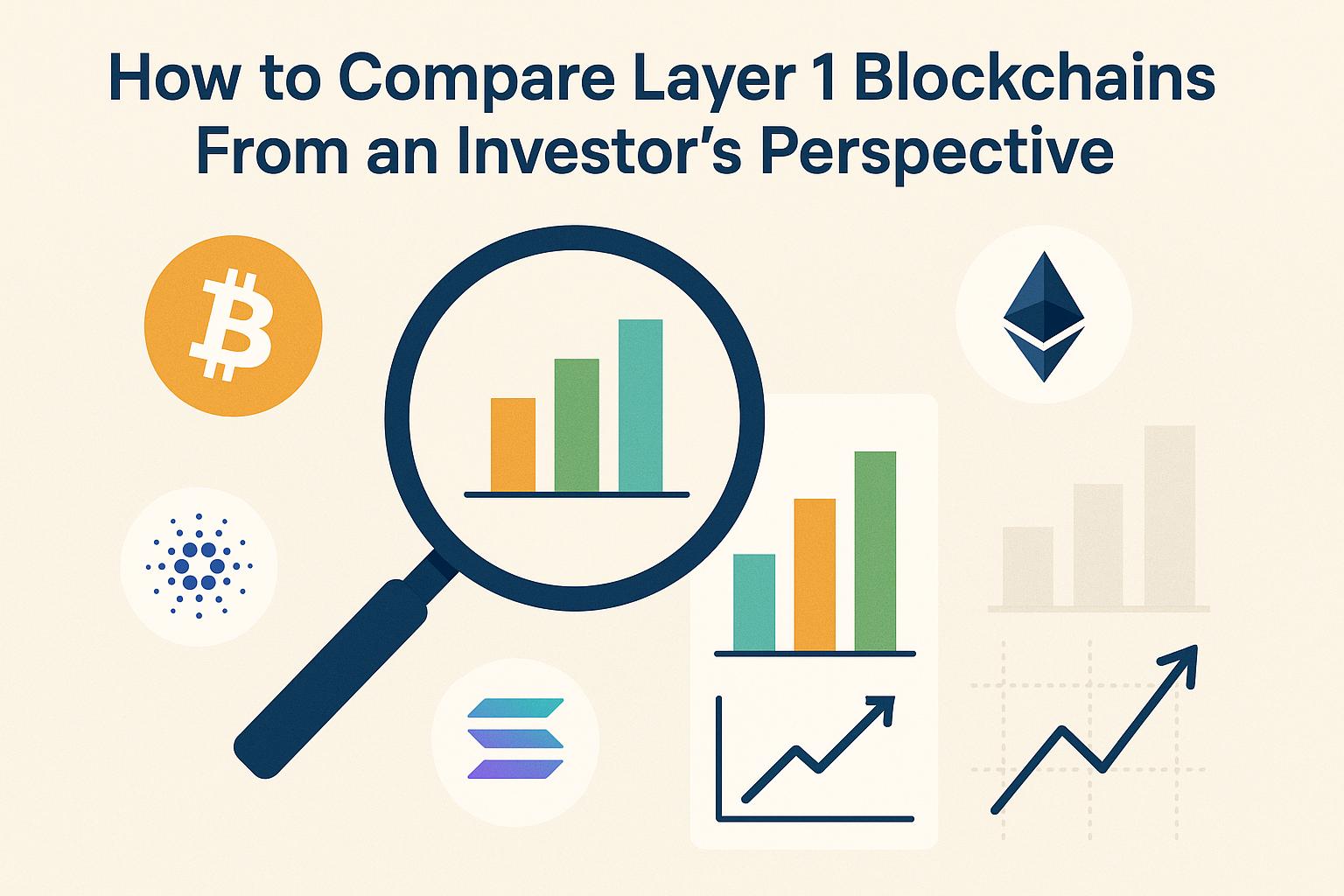
For investors, evaluating a Layer 1 blockchain requires a structured and multidimensional approach. Price trends alone do not reflect long-term viability. Instead, a comprehensive assessment should incorporate technology design, scalability capacity, security framework, decentralization characteristics, ecosystem growth, economic incentives, governance structure, regulatory exposure, and competitive positioning. Each of these variables contributes to the sustainability of the network and the potential appreciation or depreciation of its native token.
This analysis framework is intended to assist investors in comparing Layer 1 blockchains using measurable, strategic, and structural factors rather than short-term market sentiment.
Technology and Scalability
The technological framework of a Layer 1 blockchain establishes the boundaries of its performance and adaptability. Differences in architecture influence transaction throughput, latency, resource requirements, and long-term upgrade capacity.
One of the primary distinguishing elements is the consensus mechanism. Proof of Work (PoW) relies on computational power to secure the network. It has a long operational history and strong security assumptions but generally consumes significant energy and may face regulatory scrutiny. Proof of Stake (PoS), by contrast, secures the network through economic stake rather than raw computing power. It reduces energy demands and can enable faster transaction processing, though it introduces new economic and governance considerations regarding validator concentration.
Emerging consensus variations—such as delegated staking, hybrid consensus systems, or Byzantine Fault Tolerant models—attempt to optimize trade-offs between speed, finality, and decentralization. Investors should examine how these mechanisms perform under stress, including high transaction loads or adverse network conditions.
Scalability remains one of the most critical constraints facing Layer 1 networks. Throughput, typically measured in transactions per second, affects a blockchain’s capacity to support decentralized finance platforms, gaming environments, enterprise usage, and other high-demand applications. However, raw throughput figures alone may not be meaningful without considering decentralization and hardware requirements. A system capable of high throughput but reliant on expensive hardware may reduce validator participation, thereby affecting network resilience.
Various scaling models are used at the base layer. Sharding divides the network into smaller processing partitions that handle transactions in parallel. Increasing block size can allow more transactions per block but may increase node resource costs. Architectural improvements such as parallel execution environments or optimized virtual machines can also improve performance.
Layer 1 scalability must also be evaluated in the context of long-term sustainability. Investors should assess whether the scalability approach maintains security and decentralization, rather than sacrificing foundational principles for speed.
Network Security and Decentralization
Security underpins the credibility of any blockchain network. Without reliable consensus and resistance to attacks, the utility of the protocol is undermined. Investors should examine a network’s historical track record, including any successful attacks, downtime, or major protocol failures.
Consensus security depends on the distribution of hashing power or staked tokens. In PoW systems, a high hash rate distributed among independent miners decreases the likelihood of a 51 percent attack. In PoS systems, the distribution of staked tokens among independent validators plays an analogous role. If a small number of entities control a substantial share of stake, coordination risks increase.
Decentralization extends beyond validator distribution. It includes client diversity, geographic dispersion of nodes, governance participation, and the accessibility of participation in network validation. A network where validation requires specialized infrastructure may drift toward centralization over time.
There is often a functional trade-off between decentralization and performance. Highly decentralized systems may process transactions more slowly because of coordination complexity and communication delays. Conversely, networks optimized for speed may reduce validator requirements or concentrate influence among select participants. Investors must consider whether the balance struck by a specific blockchain aligns with long-term stability goals.
Security audits, formal verification processes, and transparent bug bounty programs also provide signals of risk management maturity. A blockchain that continuously upgrades its protocol through structured improvement proposals demonstrates resilience, provided changes are thoroughly tested and widely reviewed.
Development Activity and Community
The development activity associated with a Layer 1 blockchain indicates its adaptability and innovation trajectory. Open-source repositories, protocol improvement proposals, and developer documentation offer quantifiable insights into the pace of enhancement and maintenance.
Frequent updates may demonstrate active stewardship, but investors should distinguish between meaningful upgrades and superficial changes. Substantial protocol improvements, security enhancements, scaling innovations, and interoperability upgrades reflect technical maturity. Developer conferences, grants programs, and hackathons also signal ecosystem expansion.
The strength of the developer community is fundamental. A network that attracts independent teams building wallets, decentralized applications, infrastructure tools, and analytics platforms increases its structural value. Developer retention is particularly important; high turnover or stagnation may reveal structural dissatisfaction or technical constraints.
The broader community also influences network durability. Validators, token holders, governance participants, educators, and infrastructure providers collectively shape the ecosystem environment. Community engagement can enhance decentralized governance participation and reduce reliance on centralized decision-makers.
However, investors should assess community vitality objectively. Metrics such as active contributors, code commits, governance proposal participation, validator counts, and infrastructure integrations provide more reliable data than social media engagement volumes alone.
Use Cases and Adoption
The real-world application scope of a Layer 1 blockchain significantly influences long-term demand for its native token. Utility creates transactional necessity, and sustained transactional necessity can support token valuation through network effects.
Different Layer 1 blockchains emphasize different verticals. Some prioritize decentralized finance applications including lending protocols, derivatives exchanges, and stablecoins. Others focus on gaming, non-fungible tokens, supply chain tracking, digital identity systems, or enterprise data solutions. The breadth and stability of these use cases determine the diversity of transactional flows.
A robust decentralized finance ecosystem often increases total value locked within applications, contributing to liquidity and user engagement. Gaming ecosystems can generate consistent transaction volumes, especially when microtransactions or asset trading are embedded. Enterprise use cases may produce lower transaction frequency but higher strategic long-term commitments.
Adoption metrics should be evaluated with care. Indicators such as daily active addresses, transaction counts, total value locked, and developer activity offer insights but may require contextual interpretation. Temporary spikes may reflect speculation or short-term incentives rather than sustained growth.
Institutional partnerships, enterprise integrations, and regulatory-compliant product launches can provide additional confidence in adoption durability. Interoperability with other chains or cross-chain bridges may expand utility but also introduce security risks. Therefore, growth strategies must be assessed alongside associated vulnerabilities.
Economic Factors
Economic architecture, often referred to as tokenomics, plays a defining role in investment analysis. The supply schedule of the native token, its distribution model, staking incentives, and fee mechanisms all affect long-term scarcity and demand dynamics.
A blockchain’s inflation rate determines how new tokens enter circulation. High issuance may incentivize validators but can dilute existing holders if not balanced by strong demand growth. Deflationary mechanisms, such as token burning tied to transaction fees, can offset issuance and influence supply scarcity.
Distribution concentration should also be examined. If early investors, insiders, or foundations hold a disproportionately large share of tokens, supply overhang risk may exist. Vesting schedules and unlock events can introduce selling pressure at known intervals, affecting market stability.
Transaction fees reflect both utility and scalability. Very high fees may restrict usability and reduce competitiveness. Extremely low fees, while attractive to users, must be economically sustainable for validators. A balanced fee market often signals a mature economic structure.
Staking yield analysis should incorporate inflation effects and real yield considerations. Nominal rewards may appear high, but if inflation offsets rewards, actual economic gain may be limited. Additionally, staking lock-up periods influence liquidity and supply dynamics in secondary markets.
Governance rights linked to the token can add another layer of economic utility. Tokens that enable protocol voting may derive value from influencing treasury allocation, parameter adjustments, and roadmap decisions. However, governance influence must be meaningful rather than symbolic.
Governance Structures and Protocol Evolution
Governance design affects how Layer 1 blockchains adapt to technological shifts and ecosystem demands. Some networks adopt on-chain governance, where token holders vote directly on protocol proposals. Others rely on off-chain coordination among developers, miners, or foundations.
On-chain governance provides transparent decision-making trails but may lead to governance concentration if voting power is correlated with token ownership. Off-chain governance may enable more deliberation but could reduce participation transparency.
Investors should assess how previous upgrades were implemented. Contentious hard forks, governance disputes, or prolonged upgrade delays can signal coordination challenges. Conversely, structured governance processes with clear improvement pathways can enhance confidence in future adaptability.
Treasury management is another governance dimension. Many Layer 1 projects allocate funds to ecosystem grants, developer incentives, research initiatives, and marketing activities. Transparent treasury management and measurable grant outcomes contribute to sustainable ecosystem expansion.
Competitive Landscape and Market Position
Layer 1 blockchains operate in a competitive environment where differentiation is essential. Investors should compare networks according to performance benchmarks, ecosystem strength, security history, and integration with infrastructure providers such as exchanges, wallet services, and custodians.
Network effects are particularly powerful in blockchain ecosystems. Once developers and liquidity concentrate on a particular chain, migration barriers increase. Established smart contract platforms often benefit from these entrenched advantages.
However, emerging Layer 1 networks may attempt to differentiate through specialized optimization. Some target high throughput for gaming, others focus on formal verification and security assurances for institutional adoption. A specialized approach can create niche dominance but may also limit ecosystem breadth.
Interoperability strategies affect competitive positioning. Some networks integrate cross-chain messaging systems or compatibility layers that allow developers to port applications from other ecosystems. Compatibility with dominant virtual machines can reduce developer onboarding friction.
Market capitalization should not be interpreted as a definitive measure of quality. It reflects market perception and liquidity conditions but may not accurately represent technological superiority or long-term viability. Comparative valuation metrics such as market capitalization relative to network revenue, transaction volume, or staking participation can provide additional perspective.
Regulatory and Compliance Considerations
Regulatory environments influence blockchain adoption trajectories. Jurisdictional treatment of native tokens as securities, commodities, or utility tokens may affect exchange listings, institutional participation, and developer engagement.
Layer 1 networks that cultivate regulatory dialogue and compliance strategies may position themselves more favorably for institutional capital. Transparent foundation structures, disclosures, and governance communication practices reduce regulatory uncertainty.
Privacy features should also be evaluated in light of regulation. While privacy-preserving technology enhances user confidentiality, it may attract regulatory scrutiny depending on jurisdiction.
Investors should consider geographic distribution of validators and developers, as regulatory actions in a concentrated region can affect network stability. A geographically diversified network may be structurally more resilient to policy shifts.
Risk Assessment and Long-Term Sustainability
Comprehensive evaluation requires balancing potential reward with identifiable risks. Technological obsolescence represents one risk; rapid innovation could render certain architectures less competitive. Security vulnerabilities, governance breakdowns, and economic misalignments also pose systemic threats.
Long-term sustainability depends on aligning incentives among validators, developers, token holders, and end users. If any group perceives persistent disadvantage, participation may decrease, weakening network strength.
Scenario analysis can assist investors in evaluating resilience. Consider how the network would perform during sustained bear markets, high transaction demand spikes, validator exit scenarios, or regulatory constraints. Stress-testing assumptions allows for more disciplined investment decisions.
Diversification across multiple Layer 1 networks may reduce exposure to protocol-specific risk. However, investors should avoid superficial diversification without thorough analysis, as many networks share correlated risk factors.
Conclusion
Comparing Layer 1 blockchains from an investor’s perspective demands a multidimensional assessment grounded in measurable structural characteristics. Technology design, scalability strategy, consensus security, decentralization metrics, development momentum, ecosystem adoption, economic architecture, governance processes, competitive positioning, and regulatory exposure collectively determine long-term viability.
No single metric provides a definitive investment signal. Instead, investors should synthesize technical, economic, and ecosystem indicators to form a comprehensive view. A disciplined evaluation framework reduces reliance on short-term speculation and supports informed capital allocation decisions within the evolving blockchain landscape.
This article was last updated on: April 1, 2026