Understanding Support and Resistance
In cryptocurrency trading, price movement rarely occurs at random. Although short-term fluctuations may appear unpredictable, closer examination of historical charts often reveals recurring behaviors around specific price areas. These areas are commonly referred to as support and resistance. They form a structural framework within which traders assess risk, define strategy, and interpret market sentiment. A detailed understanding of these concepts enables traders to interpret charts more effectively and respond to evolving market conditions with greater consistency.
Support and resistance are foundational components of technical analysis. They represent zones where buying or selling pressure historically outweighs the opposing force. By identifying these zones, traders attempt to anticipate potential pauses, reversals, or continuations in price movements. While no method guarantees precise predictions, careful observation of these levels improves decision-making by anchoring analysis in observable price behavior.
Defining Support and Resistance
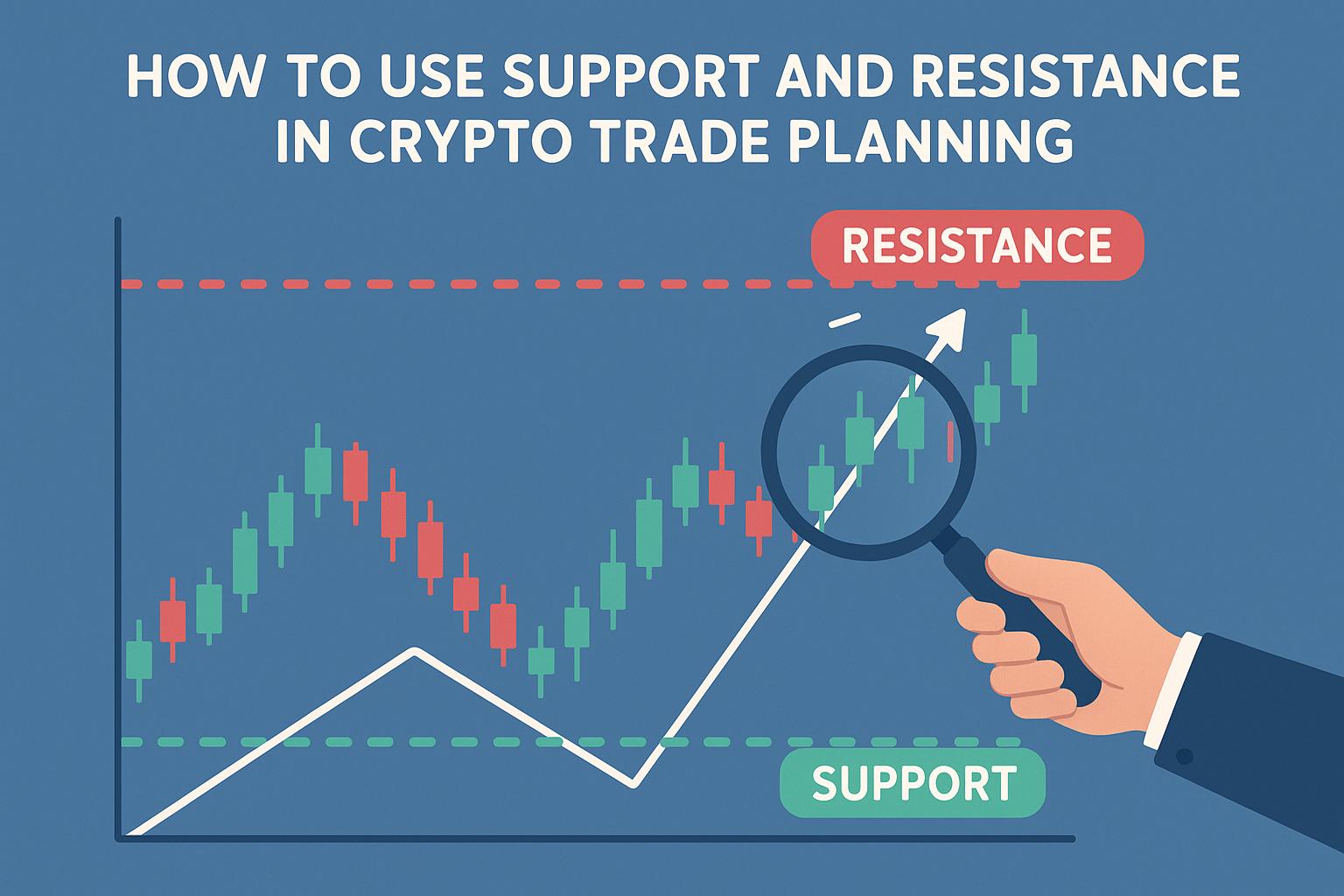
Support is a price level where downward movement tends to pause due to increasing demand. When a cryptocurrency declines toward a support area, buyers frequently begin to enter the market, perceiving the asset as reasonably valued or undervalued. This concentration of demand may temporarily halt or reverse the decline. The more often price reacts positively at a particular level, the more attention traders give to that zone.
For example, if Bitcoin repeatedly declines to a specific price range and rebounds from that area, traders interpret it as evidence that buyers are consistently willing to purchase at that level. Over time, this repeated reaction strengthens the perception of support, reinforcing its influence on subsequent trading decisions.
Resistance, by contrast, is a price level where upward momentum tends to slow due to increasing selling pressure. When price rises toward a resistance zone, traders who view the asset as overvalued may sell, while others who entered earlier positions may take profits. This supply can exceed demand, leading to consolidation or reversal. As with support, repeated reactions at a resistance level increase its perceived importance.
Support and resistance should not be viewed as exact price points. Instead, they are better understood as zones or ranges. Cryptocurrency markets often exhibit volatility that temporarily breaks through levels before reversing. Recognizing this flexibility helps traders avoid rigid interpretations and consider broader market context.
The Market Mechanics Behind These Levels
Support and resistance emerge from the interaction between buyers and sellers. Market participants base their actions on prior price behavior, trading volume, fundamental developments, and broader macroeconomic influences. When a particular price range has historically triggered significant buying or selling, traders remember that activity. Many trading decisions are influenced by prior experiences, creating a degree of repetition in price reactions.
Order flow contributes significantly to these zones. Large institutional participants may place substantial buy orders near support areas or sell orders near resistance areas. Retail traders often mirror visible patterns, reinforcing collective behavior. Over time, clusters of pending orders accumulate around these levels, increasing the likelihood of price reaction when approached again.
Market memory also plays a critical role. If traders recall entering profitable trades at certain price points, they may attempt to re-enter at similar levels when price revisits those areas. This collective memory contributes to recurring volatility around established zones.
Analyzing Support and Resistance Levels
Traders typically rely on chart analysis to identify key support and resistance zones. Historical price action provides the most direct evidence. By examining previous highs and lows, traders locate areas where market direction changed or paused. These turning points offer practical reference points for anticipating future reactions.
Simple charting tools such as horizontal lines are commonly used to mark repeated reaction areas. When price forms multiple lows at a similar level, a horizontal support zone can be drawn. Similarly, repeated highs suggest resistance. The accuracy of these zones improves when accompanied by strong trading volume, as high volume indicates substantial market participation at that price.
In addition to horizontal levels, dynamic forms of support and resistance appear in trending markets. In an uptrend, successive higher lows may form an upward sloping trendline that acts as support. Conversely, in a downtrend, lower highs may form a descending trendline representing resistance. These diagonal levels reflect changing market structure over time.
Another important aspect is timeframe selection. Support and resistance observed on higher timeframes, such as daily or weekly charts, generally exert greater influence than levels identified on shorter intervals like five-minute charts. Long-term participants often engage around broader structural levels, whereas short-term traders focus on narrower fluctuations. Comparing multiple timeframes allows traders to distinguish between minor intraday levels and major structural zones.
Range-Bound and Trending Markets
Market conditions influence how support and resistance behave. In range-bound environments, price frequently oscillates between clearly defined support and resistance levels. Traders may repeatedly buy near support and sell near resistance while the range persists. Such conditions can continue until a significant change in demand or supply generates a breakout.
In trending markets, however, behavior differs. During strong uptrends, previous resistance levels may transform into new support after being broken. This concept, often referred to as role reversal, demonstrates how market expectations adjust. Once price closes convincingly above resistance, sellers who previously acted there may withdraw, while buyers view the former ceiling as a new floor.
The reverse applies in downtrends. Broken support may later function as resistance if price revisits that level from below. Recognizing role reversals helps traders understand how structural shifts reinforce trend continuation.
The Role of Psychological Levels
Support and resistance do not arise solely from chart patterns. Psychological influences also shape market behavior. Round numbers commonly attract attention. Price levels such as $10,000, $20,000, or $50,000 in Bitcoin often serve as focal points because they are easy reference values. Traders may cluster buy or sell orders around these numbers, amplifying their importance.
Human decision-making tends to favor simplicity. Round figures are easier to recall and communicate, which increases their visibility in public discourse and trading plans. When large numbers of participants anticipate reactions around these levels, their collective behavior can transform expectations into actual price effects.
Psychological levels may coincide with historically significant highs or lows. When these elements align, the resulting support or resistance zone can become especially influential. Observing both numerical significance and historical price behavior improves analytical precision.
Integrating Support and Resistance in Trading Strategies
Effective application of support and resistance requires more than identification. Traders must determine how to incorporate these levels into structured trading plans. Decisions surrounding entry, exit, and risk management are often anchored to recognized zones.
When price approaches an established support level within a broader uptrend, some traders consider entering long positions in anticipation of a rebound. Stop-loss orders may be placed slightly below the support range to limit potential losses in case the level fails. Profit targets may be set near resistance or according to measured risk-reward ratios.
Similarly, when price approaches resistance within a range or weak trend, traders may consider short positions, anticipating a reversal. Stops are often positioned above resistance to protect against upward breakouts.
Breakouts introduce a different dynamic. A breakout occurs when price moves decisively beyond a support or resistance level with accompanying momentum and increased trading volume. Rather than reversing, price continues in the breakout direction. Breakout traders typically seek confirmation through strong candle closes and volume spikes before entering positions aligned with the new direction.
False breakouts must also be considered. Cryptocurrency markets are known for volatility that briefly penetrates established levels before reversing sharply. Waiting for confirmation, such as sustained price acceptance above resistance or below support, can help reduce exposure to premature entries.
Using Indicators for Confirmation
Technical indicators are frequently used alongside support and resistance analysis to improve reliability. While price action alone provides primary evidence, indicators offer supplementary context.
Moving Averages smooth price data and can act as dynamic support or resistance. In trending markets, price may repeatedly rebound from a key moving average, reinforcing its technical significance. When a moving average aligns with a horizontal support zone, the combined influence may strengthen the area.
The Relative Strength Index (RSI) measures momentum and helps identify overbought or oversold conditions. If price approaches resistance while RSI signals overbought conditions, the probability of temporary consolidation or retracement may increase. Conversely, oversold readings near support can suggest declining selling pressure.
Volume indicators also play a central role. Breakouts accompanied by unusually high volume are generally considered more credible than those occurring on limited participation. Volume reflects commitment from market participants and provides insight into the strength behind price movements.
Indicators should not be treated as independent decision-making systems. Instead, they are most effective when confirming observable price structures. Combining indicators with clearly defined support and resistance zones allows traders to balance structure with momentum analysis.
Timeframe Alignment and Context
A critical aspect of applying support and resistance lies in understanding broader market context. Levels on higher timeframes tend to carry greater weight because they represent prolonged periods of market consensus. A weekly resistance level, for instance, often influences price direction more significantly than a short-term intraday high.
Multi-timeframe analysis helps traders avoid entering positions directly into major opposing zones. A short-term breakout on a fifteen-minute chart may encounter immediate resistance visible on a daily chart. Assessing alignment between timeframes reduces conflicting signals and supports coherent strategy development.
Context also includes macroeconomic conditions, regulatory developments, and overall cryptocurrency market sentiment. While support and resistance are technical constructs, external events can generate volatility that temporarily overrides established levels. Monitoring broader influences ensures technical analysis remains adaptable.
Risk Management and Structural Discipline
Support and resistance provide structural reference points that are especially valuable for risk management. Traders must decide in advance how much capital to risk and where to exit if expectations prove incorrect. Well-defined levels simplify this process.
For example, placing stop-loss orders just beyond support or resistance zones limits downside exposure if a breakout invalidates the setup. Position sizing can also be calculated based on the distance between entry and stop levels, ensuring consistent risk parameters across trades.
Without predefined levels, trading decisions may become reactive and inconsistent. By contrast, anchoring decisions to observable price structures promotes systematic evaluation. Even unsuccessful trades can be reviewed objectively when based on clearly identified zones.
Continuous Learning and Adaptation
Cryptocurrency markets are characterized by rapid innovation, variable liquidity, and evolving participation. As a result, support and resistance levels are not permanent fixtures. What once acted as strong resistance may lose significance as market conditions shift.
Traders should regularly update charts to reflect new highs, new lows, and changes in trend structure. Historical data remains valuable, but recent activity often carries more immediate relevance. Observing how price reacts when revisiting old levels can reveal whether market participants still consider them meaningful.
Continuous observation also helps refine judgment regarding zone width, confirmation signals, and breakout quality. Experience improves the ability to distinguish between minor price fluctuations and structurally important shifts.
In cryptocurrency trading, support and resistance serve as practical tools for organizing market information. They provide insight into supply-demand dynamics, guide entry and exit decisions, and support disciplined risk management. When combined with technical indicators, volume analysis, and multi-timeframe context, these levels become integral components of a structured trading methodology. Adaptation, review, and ongoing analysis remain essential, as market conditions evolve and redefine the significance of each level over time.
This article was last updated on: June 6, 2026